My father said that the reason he married my mother was that when they met she could name all the Montreal Canadiens. I'm pretty sure that it was, in fact, at least a contributing factor. His love of sports not only helped him choose a life partner but also raise his children, and before I could drive I had been lucky enough to attend sporting events of all varieties across North America. As a young buck I saw the Habs play at the Forum (spiritual), attended more college and pro football games than I could count (educational), and watched minor league baseball in Albequerque (random).
But among the plethora of live events I attended, nothing was ever quite like the Ironman triathlons I've witnessed in my second hometown of Lake Placid over the past decade or so. Indeed, a full Ironman event is something that has to be seen to be understood - from the cannon going off at 7:00 a.m. and seeing two thousand people clawing and thrashing in a turbulent 3.8km white-water ballet, to the geeks in their aerodynamic helmets hammering their way through the 180km bike, all the way to the final stragglers gritting their teeth and trying to finish the full 42.2km marathon before the midnight cutoff.
And it is that midnight hour that I find always the most inspiring. Watching a pro cruise across the finish line in nine hours is impressive and all, but there is something special about watching a grown adult on the brink of losing control of his bodily functions or forgetting her name, being cheered on by a couple of thousand pumped up spectators in the heart of the Adirondack Mountains in the middle of the night. Those final competitors are trying desperately to make it over the line in time to avoid the dreaded DNF (Did Not Finish) that is given to anyone who does not complete the entire 226km (140.6 mile) race before the clock strikes twelve.
The crowd becomes an integral part of the Ironman experience as midnight approaches. Competitors who finished earlier in the day, families, friends and locals number into the thousands as they convene at the outdoor speedskating oval that doubles as the finishing stadium in the center of town. They stand on the bleachers or recline on the hill that leads up to the old stone high school that overlooks the festivities. Music pumps from the P.A. system (the same top-40 and oldies soundtrack that you are likely to hear at Uncle Sal's third wedding or watch awkward politicians dance to at a convention) while Mike Reilly - "the voice of Ironman" - rallies the crowd to cheer on those remaining few athletes who are trying to finish the run-come-death-march. And there are prizes. Not for the athletes this time, but given to the audience as the organizers rely on that universal truth of spectator sports: nothing makes white people yell and scream like the promise of a free t-shirt thrown at them by a marketing intern.
The prizes aren't altogether lame, though. Four years ago I had a hat land at my feet. As far as baseball caps go, it seemed exotic to me at the time: made primarily of white mesh with a terry-cloth type of sweat band sewn into it and adorned with the name of one of the race's sponsors, it was probably the first ball cap I had ever seen that wasn't made entirely out of cotton or wool. It was more a piece of gear than a casual adornment, and it was of the ilk that the day's rock stars - being the 2,000 athletes competing - wore as they completed the run. Since I was twenty five years old at the time and not, say, seven, I won't recall that I was altogether enamored with the hat. But I was suitably taken that I picked it up and tucked it under my arm, deciding that while I didn't have use for such a hi-tech piece of head wear at that point in my life (I was still rocking my foam/mesh "Earl" trucker hat on a full-time basis), I might have occasion to use it at some point down the road. I took it home and tossed it onto my desk before bed that night.
I have changed residences several times since then, and have always taken the hat with me, finding room in a bag as I've been in transit or on a hook in someone else's apartment as I've squatted for a few months. All the while I've resisted actually putting it to use, instead deciding that wearing the hat was something that I would have to earn, and day dreaming in the back of my mind of the day when I would cut the tags off and bring the hat's place in my life full circle. It may seem like a reach, but as I've found it in the bottom of my designer suitcase (read: hockey bag) or glanced at it buried on a closet shelf, the hat has been a constant reminder of a goal that has at times seemed larger-than-life, but has loomed closer as I've honed my swimming, biking and running chops over the past few years.
And so it will be this Sunday, in that mountain town that I love, where I will be part of the early morning white-water ballet, where I will power through that half-day grind on the bike, and where sometime before supper I will slip on the crisp, white hat as I seek to be among those who finish before midnight. While there is much that will be out of my hands come race day, I can rest well until then knowing that I have the perfect piece of head gear.
Wednesday, July 21, 2010


Sunday, February 14, 2010
Across the Great Divide
The reason we decided to move to Colorado can be summed up in four words: Rocky Mountain National Park. It was on a sunset drive over the spine of the Continental Divide - which bisects the Park - with elk grazing indifferently beside the road in the shadow of 14,000 foot mountains last June that we realized this was the place for us. A few months later we moved to Boulder, and a couple of recent trips back into that giant playground have reinforced to us that moving to within one CD's drive of Rocky Mountain National Park was probably a good idea. One such trip took place yesterday afternoon, when we threw the cross-country skis in the back of the car (alright, they were still in there from the last trip) and headed for the mountains.
The drive from Boulder to the town of Estes Park and the eastern entrance to RMNP is a pretty one, as a traveler gains elevation (around 2,000 feet) and loses population. Our late start yesterday meant that we had the pleasure of enjoying the drive in the bright afternoon sunshine., and spirits were high as we stopped in Estes Park for some water and granola bars.
After passing through town and approaching the park itself, we we noticed several cars pulled over to the side of the road about a quarter-mile shy of the entry station. When dealing with Americans in national parks, this means one of two things: snack bars or wildlife. To our delight, the attraction in this case was not 700-calorie ice cream sandwiches served up by a disenchanted local sophomore with acne and a hair net, but a herd of elk numbering in the triple digits grazing by the roadside.
We encountered a similar site when we pulled into the park last week as well. In that instance we stood dumbfounded beside the car, speaking in hushed, revered tones and listening only to the percussion of hooves crunching the dried vegetation. Wanting to be closer to the animals but knowing that physically approaching would be an affront both to their right to enjoy their meal and my right not to be trampled, I opted to experience the animals using my soles. Off came the hiking boots and socks as I inched my way from the paved shoulder onto the same meadow grasses where the herd was grazing a few meters away. It is a most spiritual thing to stand barefoot on the same grass as creatures so simultaneously gentle and imposing, and my senses of connectedness and humility ran deep from the ground up.
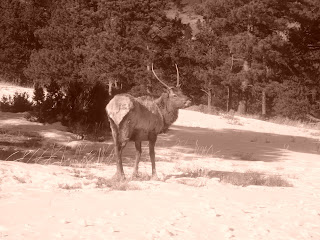 Photo by Fitzpatrick
New snow had fallen since that previous encounter, however, so a similar scene would not be recreated yesterday. After sitting silently on the hood and watching a few calves approach within two car lengths, I jumped back in the car and we headed up Trail Ridge Road, towards our skiing. Trail Ridge Road is the section of highway 34 that climbs to some of the Park's highest elevations, and is the same one that we drove last summer when we realized we needed to move here. In winter, however, the road is closed at its highest elevations for the obvious safety reasons. Fortunately, it turns out that a closed winter road in the Rockies can make for an ideal skiing and snowshoeing trail, and we snaked our way up the road until the barricades, at which point we traded wheels for skis and kept heading up.
The road-turned-trail starts off wide and heavily traveled, with skis being largely unnecessary for the first kilometer or so as one crunches over snow that has been well trampled not just by backcountry adventurers, but also curious tourists who may not advance more than a couple of hundred meters from their cars (but good on them for exploring what lies beyond the end of the road). Eventually, the trail starts to narrow. Sure, it is still almost as wide as a two-lane road, but the two-to-three feet of fresh powder that covers it make it nearly impossible to ski upward, unless you stay in the tracks that have been carved down the center by previous skiers. I have to admit to feeling a little bit hard core as the trail continually narrowed, funneling me into the middle as I skied past road signs that were buried up to their necks, and took in top-of-the world views that I had to earn by pumping the legs, rather than sitting on a lift.
 Photo by Shouldice
We skied steadily upward for a couple of hours, gradually gaining elevation until we were probably somewhere around 11,000 feet. Our turning point was above a clearing that allowed us to look back down the mountain which we had just skirted, to the meandering river on the valley floor and the naked, jagged peaks in the distance. The sunset was just finishing its (weather permitting) daily spectacle, with its final pinks and oranges playing out in narrow strips slicing the very tops of the mountains at the far end of the valley. A chill was setting in as we started our descent.
To take a trip into the Colorado backcountry in February is to journey into a muted magnificence as the land holds its frozen breath and waits for spring. There is a powerful silence brought on by the cloaking of snow, and the rumblings and echoes that permeate the hillsides and valleys during the rest of the year are dampened, with only the occasional nearby rustle managing to reach the visitor's ear.
And yet, with this silence can come a stark amplification of other senses. Skiing back down the road in the post-sunset alpenglow of the early evening, there was a rare and sacred intensity in the colours of the Park. An intensity that seemed to swell as the daylight faded. The golds of the dead and stunted grasses were as bright as under the Prairie sun. The brown bark of the deciduous trees was as rich as the finest mahogany. And the purple wedge of sky that we were descending towards was woven of a fabric fit for the artist currently known as Prince.
And then during our last kilometer or so the glow subsided. Where the afternoon snow had sparkled hours earlier, and the yellow rocks had glistened like buttered pancakes just moments before, we were now gliding through a tunnel of dusky and unsettling shadows, arriving back at the car just as headlamps (which we did not have) became a necessity. We drove down the rest of the road largely in silence as the faint outlines of elk, barely visible under the evening's first stars, dotted the meadowed landscape.
The drive from Boulder to the town of Estes Park and the eastern entrance to RMNP is a pretty one, as a traveler gains elevation (around 2,000 feet) and loses population. Our late start yesterday meant that we had the pleasure of enjoying the drive in the bright afternoon sunshine., and spirits were high as we stopped in Estes Park for some water and granola bars.
After passing through town and approaching the park itself, we we noticed several cars pulled over to the side of the road about a quarter-mile shy of the entry station. When dealing with Americans in national parks, this means one of two things: snack bars or wildlife. To our delight, the attraction in this case was not 700-calorie ice cream sandwiches served up by a disenchanted local sophomore with acne and a hair net, but a herd of elk numbering in the triple digits grazing by the roadside.
We encountered a similar site when we pulled into the park last week as well. In that instance we stood dumbfounded beside the car, speaking in hushed, revered tones and listening only to the percussion of hooves crunching the dried vegetation. Wanting to be closer to the animals but knowing that physically approaching would be an affront both to their right to enjoy their meal and my right not to be trampled, I opted to experience the animals using my soles. Off came the hiking boots and socks as I inched my way from the paved shoulder onto the same meadow grasses where the herd was grazing a few meters away. It is a most spiritual thing to stand barefoot on the same grass as creatures so simultaneously gentle and imposing, and my senses of connectedness and humility ran deep from the ground up.
 Photo by Fitzpatrick
New snow had fallen since that previous encounter, however, so a similar scene would not be recreated yesterday. After sitting silently on the hood and watching a few calves approach within two car lengths, I jumped back in the car and we headed up Trail Ridge Road, towards our skiing. Trail Ridge Road is the section of highway 34 that climbs to some of the Park's highest elevations, and is the same one that we drove last summer when we realized we needed to move here. In winter, however, the road is closed at its highest elevations for the obvious safety reasons. Fortunately, it turns out that a closed winter road in the Rockies can make for an ideal skiing and snowshoeing trail, and we snaked our way up the road until the barricades, at which point we traded wheels for skis and kept heading up.
The road-turned-trail starts off wide and heavily traveled, with skis being largely unnecessary for the first kilometer or so as one crunches over snow that has been well trampled not just by backcountry adventurers, but also curious tourists who may not advance more than a couple of hundred meters from their cars (but good on them for exploring what lies beyond the end of the road). Eventually, the trail starts to narrow. Sure, it is still almost as wide as a two-lane road, but the two-to-three feet of fresh powder that covers it make it nearly impossible to ski upward, unless you stay in the tracks that have been carved down the center by previous skiers. I have to admit to feeling a little bit hard core as the trail continually narrowed, funneling me into the middle as I skied past road signs that were buried up to their necks, and took in top-of-the world views that I had to earn by pumping the legs, rather than sitting on a lift.
 Photo by Shouldice
We skied steadily upward for a couple of hours, gradually gaining elevation until we were probably somewhere around 11,000 feet. Our turning point was above a clearing that allowed us to look back down the mountain which we had just skirted, to the meandering river on the valley floor and the naked, jagged peaks in the distance. The sunset was just finishing its (weather permitting) daily spectacle, with its final pinks and oranges playing out in narrow strips slicing the very tops of the mountains at the far end of the valley. A chill was setting in as we started our descent.
To take a trip into the Colorado backcountry in February is to journey into a muted magnificence as the land holds its frozen breath and waits for spring. There is a powerful silence brought on by the cloaking of snow, and the rumblings and echoes that permeate the hillsides and valleys during the rest of the year are dampened, with only the occasional nearby rustle managing to reach the visitor's ear.
And yet, with this silence can come a stark amplification of other senses. Skiing back down the road in the post-sunset alpenglow of the early evening, there was a rare and sacred intensity in the colours of the Park. An intensity that seemed to swell as the daylight faded. The golds of the dead and stunted grasses were as bright as under the Prairie sun. The brown bark of the deciduous trees was as rich as the finest mahogany. And the purple wedge of sky that we were descending towards was woven of a fabric fit for the artist currently known as Prince.
And then during our last kilometer or so the glow subsided. Where the afternoon snow had sparkled hours earlier, and the yellow rocks had glistened like buttered pancakes just moments before, we were now gliding through a tunnel of dusky and unsettling shadows, arriving back at the car just as headlamps (which we did not have) became a necessity. We drove down the rest of the road largely in silence as the faint outlines of elk, barely visible under the evening's first stars, dotted the meadowed landscape.
Thursday, February 11, 2010
Covers of Songs and Books
The bookstore sits by the edge of the highway that slows down as it arcs through through the tiny town. The building is sunken by a few feet, so the windows look out at ground level. As for the store, it consists of a main room that is the size of an average suburban living room, with a couple of smaller secondary rooms and a long hallway where they serve the ice cream, hot drinks and baked goods. The walls are lined with the the cracked spines of thousands of used books, and the familiar smell of yellowing pages mingles on the stale air with the heavy scent of dark roast.
In a town with as much musical talent and appreciation as Nederland, Colorado, pretty much any public space can be turned into a makeshift performance venue. And so at Blue Owl Books (not to be confused with Boulder Bookstore, where I collect a pay cheque every two weeks), music happens most Saturday nights and one Thursday a month. The Thursday gig is always filled by the same duo, a local married couple named Billy and Jill who we went to see tonight. I had never seen them play together, although I've seen the husband work his flat-picking magic a time or two with his other band. You see, Billy Nershi is the singer and lead guitar player for the String Cheese Incident, and the String Cheese Incident is a band that I have traveled high and low to watch work their magic over the better part of a decade. My most recent "Incident" was this past summer in Rothbury, Michigan along with 20, 000 of my fellow Cheeseheads. Given that I am used to seeing Billy playing with the Cheese in front of thousands, I was thrilled to get the tip-off from a co-worker that he and Jill would be at the bookstore tonight.
We arrived just as they were warming up in the main room - two musicians, two guitars and one completely unnecessary microphone. Benches had been brought in to handle the crowd, though the event turned into standing room only once the eighteenth and nineteenth spectators arrived. We positioned ourselves on the second bench back, with Sarah sitting right next to the bed where the shop's resident cat slept during most of the show. After a quick warm up and friendly greeting (more "Hi there, friends" than "Hello Cleveland!") the Nershis settled into two wonderful sets of bluegrass and country standards, folk songs and a couple of String Cheese favourites. I have been in dorm room jam sessions that have had more people in attendance, and the intimate setting lent itself more to the vibe of friends picking in a basement than a formal performance. Granted, formality has a way of going right out the door as soon as the performers start passing their bottle of tequila around among the audience.
There is magic to be seen in watching someone play music for the sheer joy of it, and there was to be no questioning of Billy's motives tonight. He could have been playing to a hundred times more people down the road in Boulder, but you could tell there was no place he'd rather be than in front of fogged windows in a drafty bookstore with his wife singing harmony and twenty friends chiming in whenever they knew the words. The man's smile was as contagious as it was natural, and when he sang "I've been spinning 'round the wheel of life, and I've made one more night," you could tell that he was grateful for it.
After a loose second set, Billy and Jill thanked everyone and put their guitars down. Billy took a seat on the first bench, sipping his beer while he struck up a conversation with our mutual friend Ryan. Ryan was quick on the introduction, and I soon found myself in a lengthy chat with Billy about some of his favourite people to play music with, and the road that led him to Nederland over the past thirty years since he left the East. I sat back and let him do most of the talking, so as to make sure it was a natural conversation between two bearded dudes in a bookshop, rather than an awkward interaction consisting of a longtime fan pestering a great musician. After a few minutes, Billy picked his guitar back up and strummed quietly while the half dozen or so of us who remained shot the breeze. Deciding this was a good time to leave, we zipped up our down coats and lowered our heads to soften the blow of the mountain wind as we slipped out the door.
Billy played on as the lone employee switched off the outside lights.
In a town with as much musical talent and appreciation as Nederland, Colorado, pretty much any public space can be turned into a makeshift performance venue. And so at Blue Owl Books (not to be confused with Boulder Bookstore, where I collect a pay cheque every two weeks), music happens most Saturday nights and one Thursday a month. The Thursday gig is always filled by the same duo, a local married couple named Billy and Jill who we went to see tonight. I had never seen them play together, although I've seen the husband work his flat-picking magic a time or two with his other band. You see, Billy Nershi is the singer and lead guitar player for the String Cheese Incident, and the String Cheese Incident is a band that I have traveled high and low to watch work their magic over the better part of a decade. My most recent "Incident" was this past summer in Rothbury, Michigan along with 20, 000 of my fellow Cheeseheads. Given that I am used to seeing Billy playing with the Cheese in front of thousands, I was thrilled to get the tip-off from a co-worker that he and Jill would be at the bookstore tonight.
We arrived just as they were warming up in the main room - two musicians, two guitars and one completely unnecessary microphone. Benches had been brought in to handle the crowd, though the event turned into standing room only once the eighteenth and nineteenth spectators arrived. We positioned ourselves on the second bench back, with Sarah sitting right next to the bed where the shop's resident cat slept during most of the show. After a quick warm up and friendly greeting (more "Hi there, friends" than "Hello Cleveland!") the Nershis settled into two wonderful sets of bluegrass and country standards, folk songs and a couple of String Cheese favourites. I have been in dorm room jam sessions that have had more people in attendance, and the intimate setting lent itself more to the vibe of friends picking in a basement than a formal performance. Granted, formality has a way of going right out the door as soon as the performers start passing their bottle of tequila around among the audience.
There is magic to be seen in watching someone play music for the sheer joy of it, and there was to be no questioning of Billy's motives tonight. He could have been playing to a hundred times more people down the road in Boulder, but you could tell there was no place he'd rather be than in front of fogged windows in a drafty bookstore with his wife singing harmony and twenty friends chiming in whenever they knew the words. The man's smile was as contagious as it was natural, and when he sang "I've been spinning 'round the wheel of life, and I've made one more night," you could tell that he was grateful for it.
After a loose second set, Billy and Jill thanked everyone and put their guitars down. Billy took a seat on the first bench, sipping his beer while he struck up a conversation with our mutual friend Ryan. Ryan was quick on the introduction, and I soon found myself in a lengthy chat with Billy about some of his favourite people to play music with, and the road that led him to Nederland over the past thirty years since he left the East. I sat back and let him do most of the talking, so as to make sure it was a natural conversation between two bearded dudes in a bookshop, rather than an awkward interaction consisting of a longtime fan pestering a great musician. After a few minutes, Billy picked his guitar back up and strummed quietly while the half dozen or so of us who remained shot the breeze. Deciding this was a good time to leave, we zipped up our down coats and lowered our heads to soften the blow of the mountain wind as we slipped out the door.
Billy played on as the lone employee switched off the outside lights.
Monday, January 4, 2010
This Must Be The Place
I am living in Boulder, and Boulder is in Colorado. At least, I'm pretty sure it is. Some days, I'm not quite sure where Boulder is.
Seminal U of T geographer Edward Relph defines placelessness as "the casual eradication of distinctive places and the making of standardized landscapes that results from an insensitivity to the significance of place" (Relph, 1976). So a placeless landscape is that which can - and does - arise anywhere, oblivious of or indifferent to any inherent human or geological variations which should make the landscape unique. When you picture your friendly neighbourhood commercial strip - complete with a Denny's, Staples and Canadian Tire - you are picturing the epitome of placelessness. It is the phenomenon of getting out of your car in Surrey, taking a look around and knowing that you could just as easily be looking at Truro and not know the difference.
The longer I am immersed in it, the more apparent it becomes to me that Boulder - in all of its residential, post-1970s boom glory, and notwithstanding its overabundance of yoga mats, dreadlocks and self-righteous liberal bumper stickers - is a study in placelessness if there ever was one. While my daily bipedal commute to either of my jobs starts off on Folsom Street and takes me West towards the mostly unique businesses of the Pearl Street pedestrian mall (set in the shadow of the Flatirons), a trip East of Folsom into the bulk of Boulder sends one into a labyrinth of chain stores, strip malls and everything else that is average and common in North America.
And while some thinkers - most notably geographer J.B. Jackson - speak to the authenticity that can be found in these seemingly inauthentic spaces, a placeless landscape is not what I came to Boulder seeking. I thought I was making a break for the mountains, but the suburbs seem to have gotten here first and have acclimatized to the altitude just fine.
So with occasional exception, Boulder hasn't quite provided the Colorado experience that we moved here looking for. We would have rather moved to a tiny mountain town, but the need for immediate employment forced our hands when we arrived, so we settled in and on Boulder: bigger than the mountain hamlets, but much smaller than Denver. The mountains are nearby, but they require at least a little bit of time and money to enjoy. Given that we don't have an abundance of time (because of our jobs) or money (also because of our jobs) right now, we have found ourselves lamenting the fact that we feel so close to, yet so far from everything we came here looking for. And so we made an unofficial New Year's resolution to make sure that we actually take the initiative required to live in Colorado while we are living in Colorado.
Step one was last Thursday night (12/29), when I invested my Grandmother's Christmas money into the local economy in the form of tickets for Sarah and I to see the Yonder Mountain String Band at a theater down the street. Yonder has been in high rotation for me since 2001, and all four band members make their home in the nearby mountain town of Nederland (NED-er-lind). The band plays fast-pickin', hard-drinkin' bluegrass music, and they do it with airtight precision that can blow the roof off a room. The last indoor show I saw them play was in Montreal to less than a couple hundred people, so to be able to dance atop the Boulder Theater balcony and watch them captivate a crowd more than ten times as big in their own backyard was quite a treat. This was a Colorado band singing Colorado songs to a Colorado crowd within a ten minute walk from our house. The show ripped, and was about as subtle as a kick to the teeth in its reminder of where we are living.
With a shared day off today, a few days removed from a Yonder show that we are still humming along to, we decided to just get in the car and drive for the mountains. We were unsure of where we were going to end up, but hopeful that it would be, well, Colorado-y, at least in terms of our romanticized notion of what that means.
We headed due east for 20 miles and reached Nederland, a mountain town we fell in love with shortly after arriving in the state. We wove through the dirt roads and rickety-yet-mountain-tough homes of old town Ned at an elevation of almost 9,000 feet (Boulder is at about 5, 400), turning south on the Peak-to-Peak highway toward Rollinsville, ten miles away.
Picture the smallest settlement you have ever been to. Now divide it in half. Got it? Rollinsville, Colorado could be a suburb of the town you are now envisioning. We're talking a tiny crossroads tucked into the mountains, where you couldn't pretend to not be in Colorado even if you wanted to. There is a post office where people who work at the watering hole can get their mail, and a watering hole where the people who work at the post office can drink, and not much else save for a smattering of single-floor residences. The pavement runs out once you get about fifteen feet into town. This isn't a problem, though, as town itself only extends about another five hundred feet. The detour into Rollinsville was a scouting mission for us, as we will be returning to town to see our current bluegrass favourites - Michigan's Greensky Bluegrass - play a show at the town's bar on January 23rd (no, really).
Back on the highway, now at over 10,000 feet we headed for the town of Black Hawk. "Oh, someone I met in Boulder was telling me about Black Hawk," Sarah said. "She told me how charming it is and how much cooler she thinks it is than Boulder." We arrived in town and parked just past the welcome sign. Sure enough, it seemed unique, charming and pretty small from what we could see although we couldn't understand why this tiny town had its own police force (a cruiser had passed us by when we first rolled in). We got out of the car and started walking.
"Hey look, a casino," I said. We laughed, thinking we were somewhere about the size of Nederland or Rollinsville, and yet there was a casino just up around the bend...and another down the street...and another around the next bend.
Wait...what?
Yeah, so Black Hawk is a major gambling center in the absolute middle of nowhere. We're talking a mini-Vegas, where every business we saw (at least 15) was at least mostly a casino, there were multi-level garages or valet parking on every block, and a fifteen-story mega-hotel and casino overlooked town. This was a total and complete non-sequitur and was a little much for us to take on our day in the mountains, so we skipped town pretty quickly (but not before making an offering to the blackjack Gods and snagging a comped Diet Coke like the high-rollers we are).
From Black Hawk (son of a bitch that place was weird) and the equally gamblo-centric and neighbouring Central City, we descended in altitude back to around the 8,000-foot mark and found our way to the Interstate. We followed I-70 West for about 20 miles, stopping briefly in Idaho Springs (Colorado still) and then ending up in Georgetown.
Georgetown. Sitting on a valley floor flanking Clear Creek, wedged so sliver-thin between the peaks that the air was painted a premature dusky gray in the late afternoon, even as the skies above were a bright blue.
Georgetown. Where on this afternoon a keen naked eye could spot a herd of big-horns (Nature!) grazing on the slopes bordering the town to the North, and the mountain lions sometimes visit from the hills to the South. Town's main street makes a feeble and insignificant border between the two sets of mountains.
Georgetown. Where mining has left and the interstate has slowed things down (easier access to the nearby ski resorts means fewer people stopping over in the winter), yet none of the 1,800 residents seems to mind. The tourists still come in the summer and the locals are content to have the run of the place in the winter, so long as the jobs at the resorts keep coming.
Georgetown is the sort of place I want to come home to some day.
After chewing the fat with a few of the locals and staying for a couple of hours and a plate of nachos, it was time to get on the road. We jumped back on the Interstate and headed East to Golden, turning North just before Denver to head back to Boulder. I'm back in my apartment now, feeling a little down to be back in my placeless new home, but grateful for the day I just had and the fresh eyes with which I can see my current situation. For the city may be where I sleep, but my living is done in the mountains.
Peace,
Hart
Seminal U of T geographer Edward Relph defines placelessness as "the casual eradication of distinctive places and the making of standardized landscapes that results from an insensitivity to the significance of place" (Relph, 1976). So a placeless landscape is that which can - and does - arise anywhere, oblivious of or indifferent to any inherent human or geological variations which should make the landscape unique. When you picture your friendly neighbourhood commercial strip - complete with a Denny's, Staples and Canadian Tire - you are picturing the epitome of placelessness. It is the phenomenon of getting out of your car in Surrey, taking a look around and knowing that you could just as easily be looking at Truro and not know the difference.
The longer I am immersed in it, the more apparent it becomes to me that Boulder - in all of its residential, post-1970s boom glory, and notwithstanding its overabundance of yoga mats, dreadlocks and self-righteous liberal bumper stickers - is a study in placelessness if there ever was one. While my daily bipedal commute to either of my jobs starts off on Folsom Street and takes me West towards the mostly unique businesses of the Pearl Street pedestrian mall (set in the shadow of the Flatirons), a trip East of Folsom into the bulk of Boulder sends one into a labyrinth of chain stores, strip malls and everything else that is average and common in North America.
And while some thinkers - most notably geographer J.B. Jackson - speak to the authenticity that can be found in these seemingly inauthentic spaces, a placeless landscape is not what I came to Boulder seeking. I thought I was making a break for the mountains, but the suburbs seem to have gotten here first and have acclimatized to the altitude just fine.
So with occasional exception, Boulder hasn't quite provided the Colorado experience that we moved here looking for. We would have rather moved to a tiny mountain town, but the need for immediate employment forced our hands when we arrived, so we settled in and on Boulder: bigger than the mountain hamlets, but much smaller than Denver. The mountains are nearby, but they require at least a little bit of time and money to enjoy. Given that we don't have an abundance of time (because of our jobs) or money (also because of our jobs) right now, we have found ourselves lamenting the fact that we feel so close to, yet so far from everything we came here looking for. And so we made an unofficial New Year's resolution to make sure that we actually take the initiative required to live in Colorado while we are living in Colorado.
Step one was last Thursday night (12/29), when I invested my Grandmother's Christmas money into the local economy in the form of tickets for Sarah and I to see the Yonder Mountain String Band at a theater down the street. Yonder has been in high rotation for me since 2001, and all four band members make their home in the nearby mountain town of Nederland (NED-er-lind). The band plays fast-pickin', hard-drinkin' bluegrass music, and they do it with airtight precision that can blow the roof off a room. The last indoor show I saw them play was in Montreal to less than a couple hundred people, so to be able to dance atop the Boulder Theater balcony and watch them captivate a crowd more than ten times as big in their own backyard was quite a treat. This was a Colorado band singing Colorado songs to a Colorado crowd within a ten minute walk from our house. The show ripped, and was about as subtle as a kick to the teeth in its reminder of where we are living.
With a shared day off today, a few days removed from a Yonder show that we are still humming along to, we decided to just get in the car and drive for the mountains. We were unsure of where we were going to end up, but hopeful that it would be, well, Colorado-y, at least in terms of our romanticized notion of what that means.
We headed due east for 20 miles and reached Nederland, a mountain town we fell in love with shortly after arriving in the state. We wove through the dirt roads and rickety-yet-mountain-tough homes of old town Ned at an elevation of almost 9,000 feet (Boulder is at about 5, 400), turning south on the Peak-to-Peak highway toward Rollinsville, ten miles away.
Picture the smallest settlement you have ever been to. Now divide it in half. Got it? Rollinsville, Colorado could be a suburb of the town you are now envisioning. We're talking a tiny crossroads tucked into the mountains, where you couldn't pretend to not be in Colorado even if you wanted to. There is a post office where people who work at the watering hole can get their mail, and a watering hole where the people who work at the post office can drink, and not much else save for a smattering of single-floor residences. The pavement runs out once you get about fifteen feet into town. This isn't a problem, though, as town itself only extends about another five hundred feet. The detour into Rollinsville was a scouting mission for us, as we will be returning to town to see our current bluegrass favourites - Michigan's Greensky Bluegrass - play a show at the town's bar on January 23rd (no, really).
Back on the highway, now at over 10,000 feet we headed for the town of Black Hawk. "Oh, someone I met in Boulder was telling me about Black Hawk," Sarah said. "She told me how charming it is and how much cooler she thinks it is than Boulder." We arrived in town and parked just past the welcome sign. Sure enough, it seemed unique, charming and pretty small from what we could see although we couldn't understand why this tiny town had its own police force (a cruiser had passed us by when we first rolled in). We got out of the car and started walking.
"Hey look, a casino," I said. We laughed, thinking we were somewhere about the size of Nederland or Rollinsville, and yet there was a casino just up around the bend...and another down the street...and another around the next bend.
Wait...what?
Yeah, so Black Hawk is a major gambling center in the absolute middle of nowhere. We're talking a mini-Vegas, where every business we saw (at least 15) was at least mostly a casino, there were multi-level garages or valet parking on every block, and a fifteen-story mega-hotel and casino overlooked town. This was a total and complete non-sequitur and was a little much for us to take on our day in the mountains, so we skipped town pretty quickly (but not before making an offering to the blackjack Gods and snagging a comped Diet Coke like the high-rollers we are).
From Black Hawk (son of a bitch that place was weird) and the equally gamblo-centric and neighbouring Central City, we descended in altitude back to around the 8,000-foot mark and found our way to the Interstate. We followed I-70 West for about 20 miles, stopping briefly in Idaho Springs (Colorado still) and then ending up in Georgetown.
Georgetown. Sitting on a valley floor flanking Clear Creek, wedged so sliver-thin between the peaks that the air was painted a premature dusky gray in the late afternoon, even as the skies above were a bright blue.
Georgetown. Where on this afternoon a keen naked eye could spot a herd of big-horns (Nature!) grazing on the slopes bordering the town to the North, and the mountain lions sometimes visit from the hills to the South. Town's main street makes a feeble and insignificant border between the two sets of mountains.

Georgetown. Where mining has left and the interstate has slowed things down (easier access to the nearby ski resorts means fewer people stopping over in the winter), yet none of the 1,800 residents seems to mind. The tourists still come in the summer and the locals are content to have the run of the place in the winter, so long as the jobs at the resorts keep coming.
Georgetown is the sort of place I want to come home to some day.
After chewing the fat with a few of the locals and staying for a couple of hours and a plate of nachos, it was time to get on the road. We jumped back on the Interstate and headed East to Golden, turning North just before Denver to head back to Boulder. I'm back in my apartment now, feeling a little down to be back in my placeless new home, but grateful for the day I just had and the fresh eyes with which I can see my current situation. For the city may be where I sleep, but my living is done in the mountains.
Peace,
Hart
Friday, November 20, 2009
Wheeeeee!
While the packing of my clothes before heading to Boulder was a process so hasty that it bordered on negligent, the decision of which of my two beloved bikes to bring was not an easy one. While a mountain bike makes more sense for winter in Boulder, my current athletic pursuits more frequently involve the skinny tires of my road bike. Back and forth I went, until I decided that leaving either bike back home would be a grave injustice both to the neglected bike and also my mother, who has been trying to get my stuff out of the garage/basement/living room for the better part of a decade. So it was that both bikes found their way to the roof of the car for the cross-country journey.
I had been out on the roadie a couple of times, but only in the past week did I head out onto a few modest dirt trails outside of town and rediscover my love for mountain biking. Last Friday I decided I had graduated from the trails skirting town itself, and took a drive into the mountains proper with my bike riding shotgun, looking for a little more excitement.
The ride at Betasso Preserve is a 3 mile (5 kilometer) loop carved into the mountains of the Front Range about a ten minute drive from town. It was near-freezing at an elevation of around 6200 feet (1,890 meters) when I parked the car, tightened my helmet's chin-strap and wondered whether wearing shorts had been the best idea. It was a bleak-yet-beautiful November afternoon. I was mostly alone on the trail and had stunning views of surrounding peaks, rocky and snow-capped set against the cold grey sky. I could see the city of Boulder six miles (ten kilometers) in the distance, neatly tucked onto the valley floor just beyond Boulder Canyon. Off I went.
I am riding my mountain bike on the side of a mountain in Colorado. Awesome.
I planned to do the loop two or three times and felt especially vigorous early on my first lap. I screamed through the downhills and thought "Hey, this isn't so hard," until it occurred to me that since this was a loop and I was enjoying so much help from gravity on the first half, I would be in for some serious climbing on the second half. The lungs burned shortly after passing the midway point and starting the climb, not used to either the elevation or having to grind my heavy mountain bike up hills. Round about the start of the second loop, a few errant flake fell from the clouds that were starting to sock me in. Not really a bona fide snowfall, but enough that I could say that it was, in fact, snowing.
I am riding my mountain bike on the side of a mountain in Colorado. And it is snowing. Awesome.
I entered the second loop and took it a little bit quicker, having scoped things out the first time around and feeling a little more comfortable in the saddle, even with some sudden drop-offs beside the single-track trail. I let myself bank a little higher in the turns and unlocked my bike's rear-suspension so that I could more comfortably bounce over rocks. As I did this, I noticed that my views of surrounding peaks were disappearing quickly as the snow fell heavier.
And heavier.
And heavier.
Wait a second, this has gone from novelty to gnarly pretty quickly. What had been a few errant flakes ten minutes before had turned into a real-deal, holy-shit-grab-your-skis-type of snow fall. It was coming down hard and I was right in the middle of it, with the dried browns of the elevated landscape turning to bright whites before I started climbing my way out of the second loop.
I am riding my mountain bike on the side of a mountain in Colorado. And it is snowing. Hard. Awesome.
With my smile growing as the snow accumulated the ride became a little trickier. Rocks became slick. The trail was tough to find in wide-open spaces where the snow was piling up the most. And in every turn my tires would spray a stinging batter of gravel, snow and mud, like someone had taken the egg beaters out of the mixing bowl. Snow was so thick on my watch that I couldn't see what time it was as I was riding, and the white stuff was piling up on my glasses as well. Thinking it to be somewhat unsafe to not be able to see, I paused for a second to clean off the ol' specs. The problem was, gear-head that I am I was wearing only non-absorbent technical fabrics at the time. So rather than sop up the snow and clean my glasses off the way a cotton t-shirt would, my wicking top simply served to spread the wealth, so to speak, smearing the snow and mud all over the lenses ensure only the soupiest of visibility.
I am riding my mountain bike on the side of a mountain in Colorado. And it is snowing. Hard. And my glasses look like the before picture in a windshield-wiper commercial. Awesome.
I spent the rest of the ride alternating between trying to see through my cataract-simulation lenses (dangerous because I couldn't see much of anything) and peering over the top of them, wincing like I had just taken a shot to the groin as my eyeballs were pelted with the icy snowflakes (dangerous because I couldn't see much of anything). The snow continued and I finished the final climb of the ride, my heart pumping and quads furious with me as I arrived back to the car, hoping that the snow caked to my bike would stay there so that I would look hard core as I drove down the mountain, through the canyon and back into town.
I often seek elements of the spiritual or sublime in my outdoor endeavours. Indeed, that search is what frequently calls me to the woods in the first place. And while there were flashes of the sacred in that high country bike ride, the best part of it was that it was, well, fun. I got dirty. I yelled "woo hoo". I went too fast and I loved the fact that it seemed like a bad idea to be out riding as the snow fell against my bare legs. If I can come away from every bike ride, run or hike with no greater insight than an appreciation of how much joy is to be found when traveling a dirt trail on a cool afternoon, then my debt to the mountains shall be endless.
Peace,
Hart
I had been out on the roadie a couple of times, but only in the past week did I head out onto a few modest dirt trails outside of town and rediscover my love for mountain biking. Last Friday I decided I had graduated from the trails skirting town itself, and took a drive into the mountains proper with my bike riding shotgun, looking for a little more excitement.
The ride at Betasso Preserve is a 3 mile (5 kilometer) loop carved into the mountains of the Front Range about a ten minute drive from town. It was near-freezing at an elevation of around 6200 feet (1,890 meters) when I parked the car, tightened my helmet's chin-strap and wondered whether wearing shorts had been the best idea. It was a bleak-yet-beautiful November afternoon. I was mostly alone on the trail and had stunning views of surrounding peaks, rocky and snow-capped set against the cold grey sky. I could see the city of Boulder six miles (ten kilometers) in the distance, neatly tucked onto the valley floor just beyond Boulder Canyon. Off I went.
I am riding my mountain bike on the side of a mountain in Colorado. Awesome.
I planned to do the loop two or three times and felt especially vigorous early on my first lap. I screamed through the downhills and thought "Hey, this isn't so hard," until it occurred to me that since this was a loop and I was enjoying so much help from gravity on the first half, I would be in for some serious climbing on the second half. The lungs burned shortly after passing the midway point and starting the climb, not used to either the elevation or having to grind my heavy mountain bike up hills. Round about the start of the second loop, a few errant flake fell from the clouds that were starting to sock me in. Not really a bona fide snowfall, but enough that I could say that it was, in fact, snowing.
I am riding my mountain bike on the side of a mountain in Colorado. And it is snowing. Awesome.
I entered the second loop and took it a little bit quicker, having scoped things out the first time around and feeling a little more comfortable in the saddle, even with some sudden drop-offs beside the single-track trail. I let myself bank a little higher in the turns and unlocked my bike's rear-suspension so that I could more comfortably bounce over rocks. As I did this, I noticed that my views of surrounding peaks were disappearing quickly as the snow fell heavier.
And heavier.
And heavier.
Wait a second, this has gone from novelty to gnarly pretty quickly. What had been a few errant flakes ten minutes before had turned into a real-deal, holy-shit-grab-your-skis-type of snow fall. It was coming down hard and I was right in the middle of it, with the dried browns of the elevated landscape turning to bright whites before I started climbing my way out of the second loop.
I am riding my mountain bike on the side of a mountain in Colorado. And it is snowing. Hard. Awesome.
With my smile growing as the snow accumulated the ride became a little trickier. Rocks became slick. The trail was tough to find in wide-open spaces where the snow was piling up the most. And in every turn my tires would spray a stinging batter of gravel, snow and mud, like someone had taken the egg beaters out of the mixing bowl. Snow was so thick on my watch that I couldn't see what time it was as I was riding, and the white stuff was piling up on my glasses as well. Thinking it to be somewhat unsafe to not be able to see, I paused for a second to clean off the ol' specs. The problem was, gear-head that I am I was wearing only non-absorbent technical fabrics at the time. So rather than sop up the snow and clean my glasses off the way a cotton t-shirt would, my wicking top simply served to spread the wealth, so to speak, smearing the snow and mud all over the lenses ensure only the soupiest of visibility.
I am riding my mountain bike on the side of a mountain in Colorado. And it is snowing. Hard. And my glasses look like the before picture in a windshield-wiper commercial. Awesome.
I spent the rest of the ride alternating between trying to see through my cataract-simulation lenses (dangerous because I couldn't see much of anything) and peering over the top of them, wincing like I had just taken a shot to the groin as my eyeballs were pelted with the icy snowflakes (dangerous because I couldn't see much of anything). The snow continued and I finished the final climb of the ride, my heart pumping and quads furious with me as I arrived back to the car, hoping that the snow caked to my bike would stay there so that I would look hard core as I drove down the mountain, through the canyon and back into town.
I often seek elements of the spiritual or sublime in my outdoor endeavours. Indeed, that search is what frequently calls me to the woods in the first place. And while there were flashes of the sacred in that high country bike ride, the best part of it was that it was, well, fun. I got dirty. I yelled "woo hoo". I went too fast and I loved the fact that it seemed like a bad idea to be out riding as the snow fell against my bare legs. If I can come away from every bike ride, run or hike with no greater insight than an appreciation of how much joy is to be found when traveling a dirt trail on a cool afternoon, then my debt to the mountains shall be endless.
Peace,
Hart
Friday, November 13, 2009
Run Like the Water
You should run like the wind, they've told me, fierce and untamed.
Our east-facing bedroom window framed a piercing Colorado sunrise as I slipped out of bed at quarter after six. A few years ago there would have been no question that seeing the sunrise on a Saturday morning would have meant I was coming off a hell of a night and looking forward to a hell of a headache. While all-nighters still happen from time-to-time, it is my inner athlete - rather than outer drinker - who now more frequently sees a day's first light.
Having been in Boulder for a few weeks, and despite a couple of modest hikes, a one-off cross-country ski and a lung-burning climb of a bike ride, I had yet to feel that I was taking full advantage of the outdoor life that we had come here seeking. So last Friday afternoon I went online and looked for any upcoming races I could do in order to kick start my active life here as I train for some physical challenges I have lined up for next summer. Sure enough, there was a 3.5 mile cross-country race in a nearby community the very next morning. Despite never having entered a cross-country race and not being entirely sure what I was in for, I promptly biked to the local running shop and plunked down my fifteen bucks for registration in the Twin Peaks Rotary XC Challenge.
You should run like an antelope, they've told me, out of control.
Though the sun had now fully emerged for its daily pilgrimage to the west , our new neighbours remained largely dormant as we pointed the car north toward Longmont, Colorado under a cloudless sky (not the rarity in Boulder that it is in Victoria this time of year).
The starts of the men's and women's races were staggered, but I huddled close to the start line of the women's wave shortly after arriving and registering, listening for any race-specific instructions. Despite my lack of cross-country experience, I figured I was in for a simple trail run, which would have been nothing new to me. Imagine my surprise, then, when I heard the race director squawk over the megaphone, "Alright, make sure you jump over the hay bales and go into the ditch. That's over the hay bales and down through the ditch. This is a cross country race, people."
Excuse me? Sorry, I'm here for the race, not the journey to Grandmother's house.
Apparently obstacles are commonplace in cross-country races, with this one being no exception. This was all somewhat foreign to me, but given that I am built more for comfort than speed and enjoy the equalizing properties of a course that doesn't have straightaways where skinny bastards can sprint (and there were skinny bastards a plenty on the course that morning), I was prepared to hop, skip and jump as necessary.
You should run like a caveman, they've told me, chasing something like your life depends on it.
There was a forty-five minute gap between the starts for the women and the men, so Sarah and I took some time to walk around the course - a three-lap beauty on grass and trails, running alongside a stream then flanking a dam, weaving in and out of some light woods. As Sarah wandered around and took pictures, I headed over toward the stream and thought about the race ahead.
I crouched beside the water, appreciative of its soothing gurgle and mesmerized by its flow, something we've all experienced at one time or another. I watched bubbles gather in a slow-moving spot on the surface, only to dissipate when they tumbled over a short ledge and into faster water below. I chuckled as the scene reminded me of runners at a start line, collecting as one until critical mass is reached, then the gun goes off and we all disperse at our own pace. The longer I experienced the stream the more metaphorical it became, its flow striking me as possessing the very same qualities that I strive for every time I set out on a run.
I have never been one to run fierce and dominant like the wind, nor out of control like the antelope, nor possessed like the prehistoric hunter. Indeed, not being terribly blessed with either a runner's physique (like I said, comfort not speed) or an attitude that is conducive to being fired up and intense for sustained periods of endurance, I have often struggled when looking for an appropriate muse. But as I crouched beside that stream and watched its flow in the minutes before the race, the inspiration that has eluded me became as clear as the high country sky.
I will run like the water, I told myself. Smooth, yet unflinching. Placid, yet interminable. Effortless, yet powerful.
And so I ran like the water, and the race became a joy. I set my own pace early on, scarcely slowing from start to finish as I made my way over the roots, stumps and hills that made up the course. There were a few moments where I thought about walking, but told myself that if I couldn't keep a steady pace for 3.5 miles cross-country on this morning - even with my recent change in altitude and current lapse in training - then I had no business looking forward to a busy season of triathlons next summer. A few recitations of my new mantra - run like the water, run like the water - helped me regain focus during moments of doubt as I flowed over the dried leaves and burnt grass. With the Flatirons in full view, I fist-pumped across the finish line in thirty-six minutes, including fifteen hay-bale hurdles and three trips in-and-out of the ditch.

Athletically speaking it was an achievement of rather modest proportions (indeed, not really an achievement at all), yet I left with a strong sense of satisfaction and renewed focus and motivation as I move ahead. I could not have asked for a better introduction to this new chapter in my inner athlete's life, and am looking forward to embracing all of the challenges and exhilaration of of running like the water from here on out.
Peace,
Hart
Tuesday, November 10, 2009
Harty Needs Your Votes
Hello there. I am interrupting your regularly scheduled blogging to ask a small favour.
The Globe and Mail is having a contest to add one writer and one photographer to its editorial team for the Vancouver/Whistler Olympics (here's a link to the contest's website). For an underemployed law school graduate with dreams of using writing to pay the bills (hey, that's me) this would be the opportunity of a lifetime.
This is where you come in.
My writing entry has been submitted, and is now open for public voting. I need to be in the top-50 vote-getters in order to proceed to the next round, where the decisions will be made by an editorial board. Your votes would mean a lot to me. So would your mother's vote, and your sister's, your dog's, etc. Here's where you can read my story and vote for it, should you so choose: LINK (regular readers will recognize this as an abridged version of a previous post).
Voting can be done daily, so please consider voting more than once (or, you know, daily). Make it part of your evening e-mail ritual, sandwiching it somewhere between writing your old landlord to threaten legal action if you don't get your damage deposit back and looking at pictures of your grade seven girlfriend on Facebook. Voting is open until November 22nd, which gives us plenty of time, although other entries were submitted weeks ago. There are certainly more noble things you can do with thirty seconds and a click of your mouse, but this really would mean the world to me. Part of why I have taken this year "off" is to work on my writing and try and do something with it, so this is an opportunity that I don't want to watch slip away.
Once again, here's the LINK (http://journalismdream.theglobeandmail.com/entry_article.asp?id=887), and note that you are eligable to win some sweet prizes (a fancy camera and a tricked-out laptop) just for voting.
Thanks, as always, for reading, and thanks in advance for voting. Also, as an added bonus, every time you vote an angel gets its wings and global warming will be reversed by one year. So really, let's all do our part.
Peace,
Hart
-----
P.S. The site did not allow me to include paragraph breaks in my submission. Here's the story as it looks with proper formatting:
Hockey becomes infused with a unique sense of community and geography when taken up by free-spirited Northerners. This I learned one afternoon last February, shortly after moving to Yellowknife.
The Great Slave Invitational is a perennial tournament serious in name only. The setting is a natural rink, complete with boards and lights, in front of cozy houseboats on Yellowknife Bay. The year I was in town, six teams competed for the highly coveted, duct tape and toilet-paper roll “Houseboat Cup” (equal parts Lord Stanley and Red Green). I manned the blue line for Team Trailer Trash, proudly representing the trailer park where I was living. Our jerseys? Sleveless undershirts sporting numbers written in mustard. I took the trailer park theme one step further, sporting borrowed skates held together with packing tape.
Scores were kept and a schedule followed. Knowing when you played next allowed maximum resting time inside the tournament host’s houseboat, with skates warming by the fire and The Hip on the stereo. With a sub-minus forty windchill outside, time inside was cherished.
After an undefeated round-robin schedule, Trailer Trash lost a heartbreaking semi-final. The overtime winner was scored by a high-flying Frenchman from Fort Smith with waist-long dreadlocks and an anomalous competitive streak. It was a tough loss, but after three games and a potato-chips-and-water subsistence all day, I was content to head home. With the final game starting and the evening winds picking up, I trudged across the bay toward my trailer and contemplated the game in a national context.
But what is that national context? I’ve recently grown weary of the hockey myths perpetuated by our macro breweries, telling us that hockey is our great national unifier. More Canadian children play soccer than hockey, and yet we are supposed to be 33 million obsessed with men dressed in garters and stockings looking to score. And while I count myself among the masses riveted by my home team's annual playoff march and the ups and downs of our national program, I am often left feeling that our frozen loyalties contain elements of the contrived and predictable, that we’re all just buying into exactly what we’re told to buy into.
And yet, an organic sense of territorial pride had grown inside me during the afternoon. The scene of the natural rink set among houseboats on a mammoth lake is not one easily duplicated elsewhere in the world, nor was it scripted by a potato chip commercial. While following the NHL's fake cold war can feel routine and formulaic, that afternoon felt spontaneous, authentic and lacking a forced sense of Canadian-ness. Indeed, the climatic and social circumstances that underscored the tournament were legitimate, inescapable byproducts of life in the far North strong and free.
Author Winona LaDuke writes of patriotism to a land but not a flag. I walked away that day feeling patriotic toward a land and a game, rather than a flag and a beer commercial.
The Globe and Mail is having a contest to add one writer and one photographer to its editorial team for the Vancouver/Whistler Olympics (here's a link to the contest's website). For an underemployed law school graduate with dreams of using writing to pay the bills (hey, that's me) this would be the opportunity of a lifetime.
This is where you come in.
My writing entry has been submitted, and is now open for public voting. I need to be in the top-50 vote-getters in order to proceed to the next round, where the decisions will be made by an editorial board. Your votes would mean a lot to me. So would your mother's vote, and your sister's, your dog's, etc. Here's where you can read my story and vote for it, should you so choose: LINK (regular readers will recognize this as an abridged version of a previous post).
Voting can be done daily, so please consider voting more than once (or, you know, daily). Make it part of your evening e-mail ritual, sandwiching it somewhere between writing your old landlord to threaten legal action if you don't get your damage deposit back and looking at pictures of your grade seven girlfriend on Facebook. Voting is open until November 22nd, which gives us plenty of time, although other entries were submitted weeks ago. There are certainly more noble things you can do with thirty seconds and a click of your mouse, but this really would mean the world to me. Part of why I have taken this year "off" is to work on my writing and try and do something with it, so this is an opportunity that I don't want to watch slip away.
Once again, here's the LINK (http://journalismdream.theglobeandmail.com/entry_article.asp?id=887), and note that you are eligable to win some sweet prizes (a fancy camera and a tricked-out laptop) just for voting.
Thanks, as always, for reading, and thanks in advance for voting. Also, as an added bonus, every time you vote an angel gets its wings and global warming will be reversed by one year. So really, let's all do our part.
Peace,
Hart
-----
P.S. The site did not allow me to include paragraph breaks in my submission. Here's the story as it looks with proper formatting:
Hockey becomes infused with a unique sense of community and geography when taken up by free-spirited Northerners. This I learned one afternoon last February, shortly after moving to Yellowknife.
The Great Slave Invitational is a perennial tournament serious in name only. The setting is a natural rink, complete with boards and lights, in front of cozy houseboats on Yellowknife Bay. The year I was in town, six teams competed for the highly coveted, duct tape and toilet-paper roll “Houseboat Cup” (equal parts Lord Stanley and Red Green). I manned the blue line for Team Trailer Trash, proudly representing the trailer park where I was living. Our jerseys? Sleveless undershirts sporting numbers written in mustard. I took the trailer park theme one step further, sporting borrowed skates held together with packing tape.
Scores were kept and a schedule followed. Knowing when you played next allowed maximum resting time inside the tournament host’s houseboat, with skates warming by the fire and The Hip on the stereo. With a sub-minus forty windchill outside, time inside was cherished.
After an undefeated round-robin schedule, Trailer Trash lost a heartbreaking semi-final. The overtime winner was scored by a high-flying Frenchman from Fort Smith with waist-long dreadlocks and an anomalous competitive streak. It was a tough loss, but after three games and a potato-chips-and-water subsistence all day, I was content to head home. With the final game starting and the evening winds picking up, I trudged across the bay toward my trailer and contemplated the game in a national context.
But what is that national context? I’ve recently grown weary of the hockey myths perpetuated by our macro breweries, telling us that hockey is our great national unifier. More Canadian children play soccer than hockey, and yet we are supposed to be 33 million obsessed with men dressed in garters and stockings looking to score. And while I count myself among the masses riveted by my home team's annual playoff march and the ups and downs of our national program, I am often left feeling that our frozen loyalties contain elements of the contrived and predictable, that we’re all just buying into exactly what we’re told to buy into.
And yet, an organic sense of territorial pride had grown inside me during the afternoon. The scene of the natural rink set among houseboats on a mammoth lake is not one easily duplicated elsewhere in the world, nor was it scripted by a potato chip commercial. While following the NHL's fake cold war can feel routine and formulaic, that afternoon felt spontaneous, authentic and lacking a forced sense of Canadian-ness. Indeed, the climatic and social circumstances that underscored the tournament were legitimate, inescapable byproducts of life in the far North strong and free.
Author Winona LaDuke writes of patriotism to a land but not a flag. I walked away that day feeling patriotic toward a land and a game, rather than a flag and a beer commercial.
Subscribe to:
Comments (Atom)